
Star Wars Episode 0 - The Rise of the Milky Way: May 2026 meeting recap

By Dirk Goës
The May 2026 meeting was held in person and on Zoom at Sydney Observatory. 42 people attended the meeting including 30 members and 12 visitors. SCS President Dr Toner Stevenson welcomed all existing and new members and acknowledged First Nations peoples. SCS Secretary, Elizabeth Cocking, updated members on matters to do with the society. Toner read out club member Garry Dalrymple’s solar observation report for the month of April.
Committee member Dirk Goës introduced our keynote speaker Dr Sven Buder from the Australian National University (ANU). Dr Sven Buder is an Australian Research Council DECRA Fellow and the principal investigator of the million-star Galactic Archaeology with HERMES Survey (GALAH) and its successor GALAH 2. You can view Sven’s personal website here. Dirk met Sven at the wonderful Starfest open day and outreach event at Siding Springs Observatory. Sven is part of the team from ANU that run this event every October Long Weekend.

Our May meeting coincided with Star Wars Day and Dr Buder grabbed the opportunity to present a Star Wars themed ride through his research work. His presentation titled “Star Wars Episode 0 - The Rise of the Milky Way” looked at how astrophysicists are slowly unravelling the formation history of the Milky Way and similar galaxies in a field of study known as Galactic Archaeology.
Sven and his collaborators analyse the chemical makeup of Milky Way stars through the large high resolution spectroscopic surveys GALAH (one million stars observed) and GALAH-2. They also incorporate data from astrometric surveys like Gaia (one billion stars observed) and galaxy surveys like Geckos. By looking at the chemical makeup of stars, they can for example determine which stars were born within the galaxy and which were accreted via a merger event. One outcome of the research has been that the most recent merger of another large galaxy into the Milky Way occurred approximately 8 to 10 billion years ago.
The data collected from these surveys is also used to inform detailed computer simulations of how galaxies form. Sven presented a video of one of these simulations that was created by his colleague Tobias Buck. It shows how the Milky Way may have formed, and the outstanding feature is the constant “bombardment” of smaller galaxies merging with the Milky Way. Sven also presented a possible timeline for the evolution of the Milky Way based on his latest research (Buder et al. 2025).
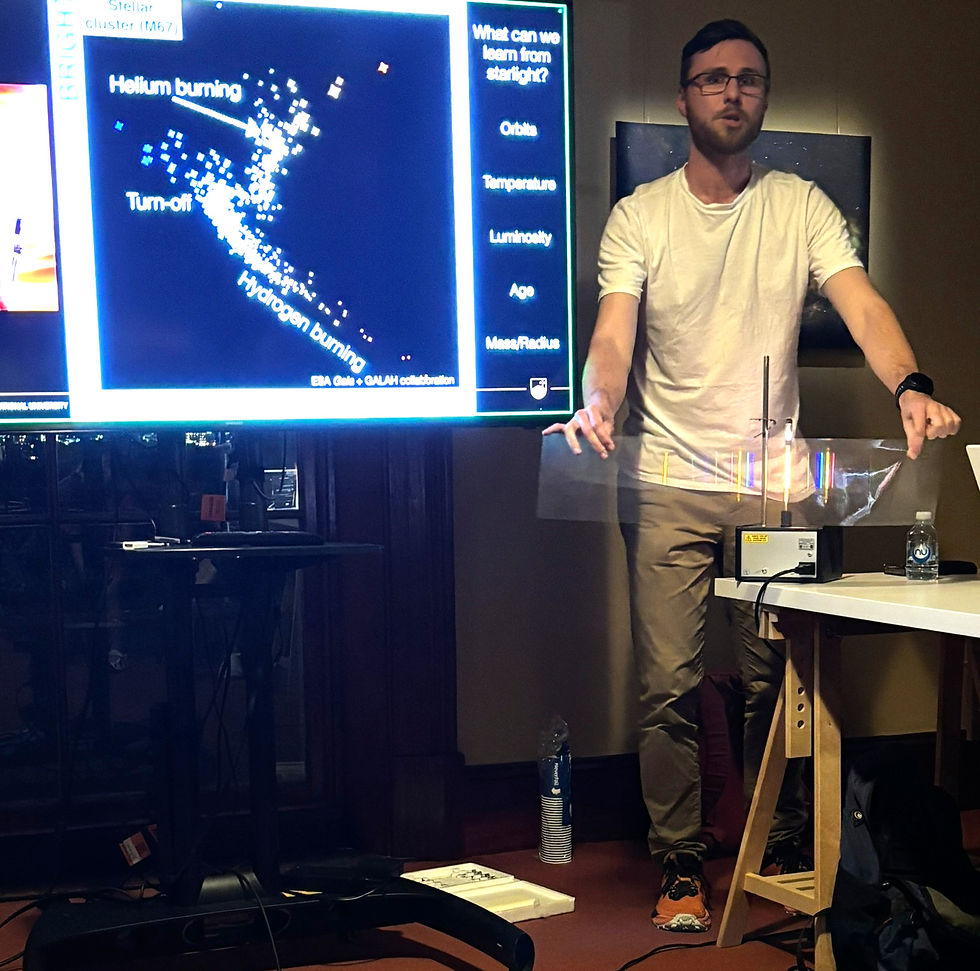
Spectroscopy is the science of breaking light into a spectrum to decipher the chemical makeup of the object that is emitting or absorbing that light. Sven gave an exciting practical demonstration of how this works. He brought in a spectrum lamp and set of spectrum tubes containing different gases. He inserted and lit up a tube containing Neon (Ne) and then Helium (He). By holding a clear plastic sheet with lines etched into it (a form of grating) in front of the light we could observe the different spectrums for these elements.
In conclusion Sven demonstrated that everything in nature is connected from the very large to the very small. Spectroscopy can be used to decipher the chemical makeup of the early universe, entire galaxies, stars, planets and life! By capturing a spectrum from the sunlight reflected off an area of vegetation it is possible to determine the dominant chemicals and for example how much water is present. Sven is involved in a project to use spectroscopy to map the flammability of bushland to improve bushfire management and prevention. This is done by capturing and analysing the reflectance spectrum of leaves.
A few highlights from the presentation are shown below.



Our next meeting Keynote address is titled “Our Sun: the work of the BAA Solar Section”. This is on-line and presented by Lyn Smith, FRAS on Monday 1st June, 6:30pm, online.
Comments